
Multnomah County Assessment and Tax Records
Multnomah County property tax records span Oregon's largest county by population. The Assessment, Recording and Taxation office maintains files on every taxable parcel, from downtown Portland condos to residential lots in Gresham, Troutdale, and Wood Village. Searching these records lets property owners and buyers find assessed values, tax bills, and ownership history. The county offers online tools that make it easy to look up Multnomah County property tax records from any device.
Multnomah County Property Tax Overview
The Multnomah County Assessment, Recording and Taxation office handles property assessment, tax collection, deed recording, and related services. The office keeps recorded indices from 1965 to the present in electronic format. These records can be searched through public access terminals or online tools.
Property owners can pay taxes online, by phone, by mail, or in person. Office hours run from 8:30 am to 4:30 pm on weekdays. The tax payment system accepts credit cards, debit cards, and electronic checks. Multnomah County property tax records track every payment and show the current balance for each account.
As Oregon's most populated county, Multnomah handles a massive volume of records. Hundreds of thousands of parcels appear on the tax rolls. The mix includes single-family homes, apartment buildings, office towers, retail sites, and industrial land. Each parcel's record holds its full assessment history and tax payment details.
Searching Multnomah County Property Tax Records Online
The multcoproptax.com portal is the main way to search Multnomah County property tax records online. Users can look up parcels by property ID, site address, owner name, legal description, map tax lot, or alternative account number. Results display current and past tax statements, assessed values, real market values, and property details.
The portal also includes a tax calculator. This tool lets owners estimate their taxes based on assessed value and the taxing districts that apply to their parcel. It breaks down how tax dollars flow to schools, the city, the county, and special districts. Sales history is available too, showing past sale dates, prices, and document references for each Multnomah County property.
The system updates on a regular cycle. Tax statements often appear online before they reach mailboxes. This gives owners early access to their Multnomah County property tax records each year.
For broader context on Oregon's property tax system, the Oregon Department of Revenue property tax page explains how the state oversees county assessors. The screenshot below shows this resource.
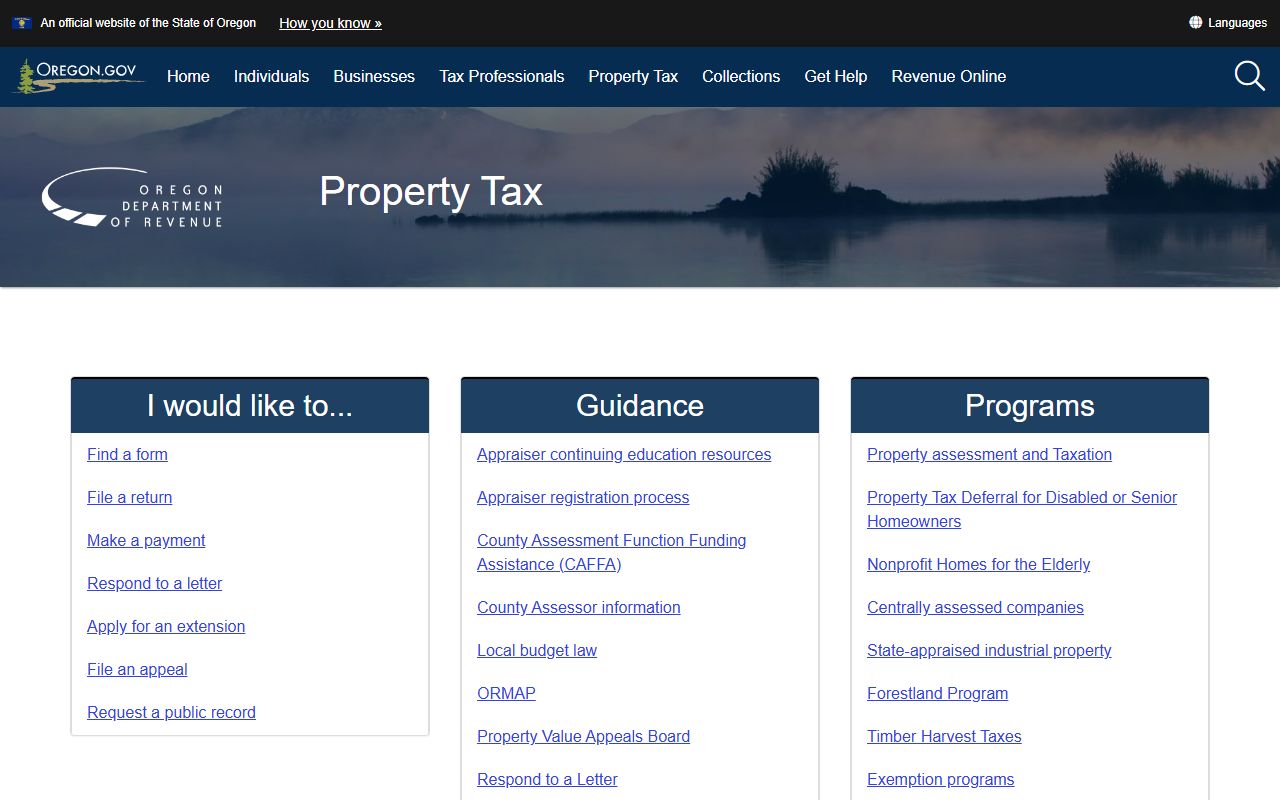
This page covers topics like Measure 5, Measure 50, and the appeal process that affect every Multnomah County parcel.
How Multnomah County Assessments Are Calculated
Every Multnomah County parcel receives a real market value, a maximum assessed value, and an assessed value each year. The real market value reflects what the property would sell for on the open market. The maximum assessed value is limited by Measure 50, which caps yearly growth at 3% under ORS 308.156.
The assessed value equals the lesser of those two figures. In a fast-rising market like Portland, many parcels have assessed values far below their real market values. A home worth $500,000 on the market might carry an assessed value of $300,000 or less. This gap is a direct result of the 3% annual cap that has been in place since 1997.
New construction gets valued using the changed property ratio. This ratio compares existing assessed values to market values and ensures new buildings are taxed in line with older ones. Under ORS 307.030, all real and tangible personal property in Multnomah County is subject to assessment and taxation unless a specific exemption applies.
Note: The gap between market value and assessed value in Multnomah County is among the largest in Oregon due to rapid price growth in the Portland metro area.
Recording Division and Property Documents
The Multnomah County Recording Division accepts deeds, mortgages, trust deeds, liens, and easements. Recorded indices from 1965 forward are available in electronic format. Documents recorded before 1965 may exist on microfilm. E-recording services allow title companies and attorneys to file documents without visiting the office.
Recording requirements include proper formatting, legibility, and correct legal descriptions. Fees follow state statute and county rules. The division does not provide legal advice on document preparation. Owners should work with an attorney or title company for complex transactions.
The Oregon State Archives holds historical Multnomah County property documents that predate the electronic index. The image below shows the archives page.
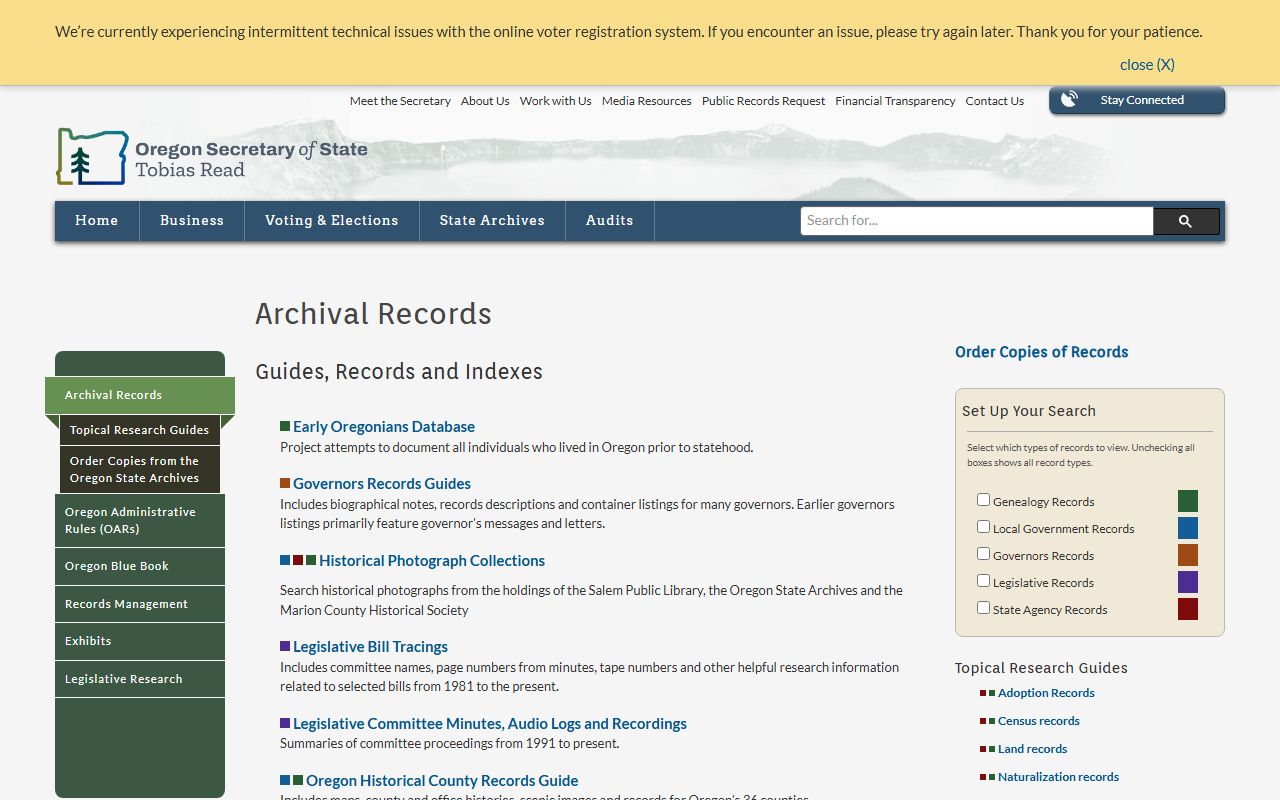
Researchers looking for older Multnomah County deeds or tax rolls can start at the state archives in Salem.
Multnomah County Property Valuation Appeals
The Multnomah County Property Valuation Appeals Board (PVAB) hears disputes from owners who believe their assessment is wrong. The board is made up of citizen volunteers appointed by the County Board of Commissioners. Members serve three-year terms and receive training on property assessment law.
Appeals must be filed after tax statements go out in late October and no later than December 31. Hearings take place between February and April. Owners may represent themselves or bring an attorney or agent. The burden of proof falls on the property owner to show that the assessed value is incorrect.
Acceptable evidence includes recent comparable sales, independent appraisals, and market analyses from licensed real estate professionals. Statistical reports and broad comparisons to neighboring properties are generally not enough. The board issues written decisions after each hearing. Owners who disagree have 30 days to appeal to the Oregon Tax Court.
- File appeals between late October and December 31
- Hearings scheduled February through April
- Written decision issued after each hearing
- 30-day window to appeal to Oregon Tax Court
Measure 5 and Measure 50 in Multnomah County
Oregon voters approved Measure 5 in 1990. It set rate limits of $5 per $1,000 of real market value for schools and $10 per $1,000 for general government. These caps apply to every Multnomah County tax bill.
Measure 50 followed in 1997. It froze assessed values at 90% of 1995 levels and capped yearly growth at 3%. The ORS Chapter 306 framework governs how these rules are carried out across all counties. In Multnomah County, the result is a large and growing gap between what properties are worth on the market and what they are taxed on.
Compression happens when the total of all district levies would exceed the Measure 5 rate caps. In those cases, taxes are reduced proportionally. This affects funding for schools, fire districts, and other local services in Multnomah County. Property tax records show the compressed amount on each tax statement, so owners can see how much was cut.
Multnomah County Tax Exemptions
Several exemption and deferral programs reduce taxes for qualifying Multnomah County property owners. Senior citizens may defer their property taxes under a state program. Veterans with service-connected disabilities can receive partial exemptions. Nonprofit organizations may qualify for full exemptions on property used for charitable purposes.
The assessor's office handles all applications. Each program has specific deadlines and requirements. The Oregon DOR public records page offers forms and guides that cover these programs statewide.
The screenshot below shows the ORS 307.030 statute page, which defines what property is subject to taxation in Oregon.
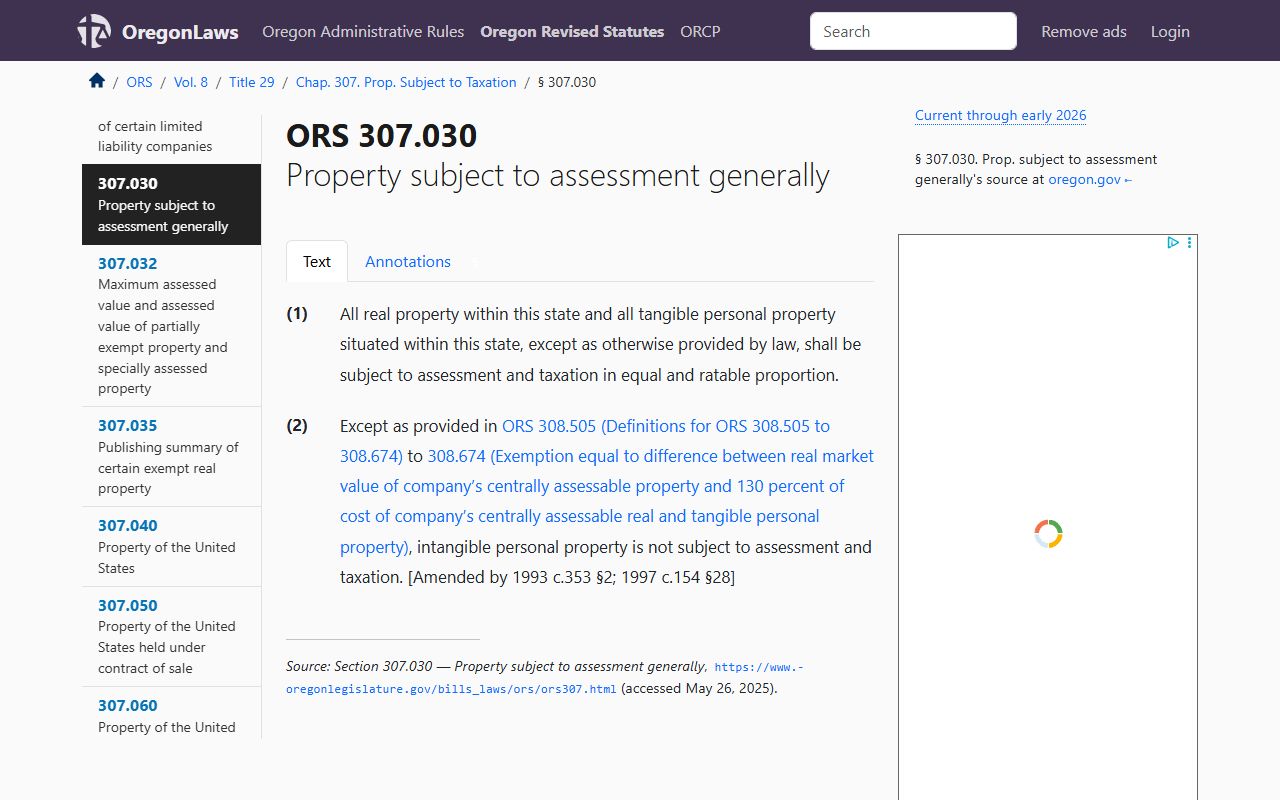
This statute establishes the foundation for property taxation that applies to every parcel in Multnomah County.
Note: Multnomah County exemption applications must meet state deadlines, which vary by program type.